
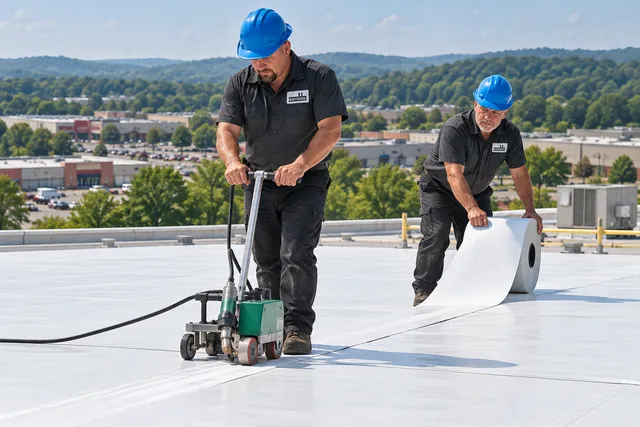
TPO Roofing
A welded white membrane replaces worn single-ply roofs on warehouses and retail buildings, often over new tapered insulation.
TPO Roofing details
Commercial Roof Repair · Florence, KY
As a Florence commercial roof repair contractor, we trace leaks on membrane and metal roofs to the failed seam, curb, drain, or edge and fix it.
A Florence commercial roof repair contractor should tell you plainly when a patch will hold and when it only delays a bigger job. These are the lines we use.
Each repair starts from what you see inside or on the roof. The chip shows how soon each condition needs work.
Spreading rings on ceiling tile mean water is feeding through wet insulation. We trace the path upslope from the stain, since roof water often runs several feet along the deck before it drips.
Open TPO laps get cleaned and rewelded with a hot-air hand welder. EPDM laps that peeled get scrubbed to fresh rubber, primed, and closed with new seam tape and a cover strip.
Curb flashing pulled loose by vibration or an HVAC swap lets water run inside the curb. New flashing goes up the curb wall and is capped with counterflashing.
Loose clamping rings, cracked drain bowls, and torn membrane in the drain sump all leak in the heaviest rain. The ring is reset, the sheet patched, and the strainer replaced.
Wind lifts the perimeter first. Loose fascia and coping get refastened, and membrane that pulled back at a corner gets a new flashing strip run under the edge metal.
Screws that walk out with heat cycling leave open holes and cracked washers. Each is pulled and replaced with a new screw and washer, one size up where the hole has worn oval.
A well-placed repair buys time on a roof that still has life in it. Here is what it does on the roof, inside, and for the budget.
Fixing the failed lap or flashing stops water where it enters, so it no longer runs along the deck to wet more insulation.
TPO gets TPO, EPDM gets EPDM, and metal panels get the same rib profile, so a repair ages the same way as the roof around it.
Once the entry point is closed, water stops reaching inventory, ceiling grid, and electrical panels below the leak.
Closing the leak path early limits how long wet insulation and ceiling tile sit damp over an occupied room.
A solid repair on a worn roof can carry it through the seasons it takes to plan and fund a full replacement.
Each repair gets dated photos and a note on what failed, so patterns at the same seam or curb are easy to spot.
Each roof system takes its own repair method. The table lists what we use on each one and where repair work ends.
| Roof System | Seam or Joint Repair | Flashing Repair | When Repair Stops |
|---|---|---|---|
| TPO | Clean and hot-air reweld | Welded TPO flashing at curbs and walls | Weathered sheet that will not take a weld |
| EPDM | Primer and seam tape | Pre-formed boots and flashing tape | Shrunken sheet bridging at walls |
| Modified bitumen or built-up | Patch over a cleaned, dried area | New base and cap flashing at walls | Wet insulation across large areas |
| PVC | Hot-air reweld | Welded PVC flashing near grease exhaust | Brittle sheet that cracks when folded |
| Metal panels | Butyl tape and stitch screws at laps | Resealed curb and wall flashing | Rust-through along eaves and end laps |
Call with the building address and where the water is landing. Set a bucket under it and keep people clear of wet ceiling tiles.
Call UsFive steps, from the first look at the stain to the water test after the fix.
We start inside at the stain, mark its spot against a column or wall, then walk the roof above it. Seams, curbs, drains, and penetrations upslope of the stain are probed and photographed.
Water can enter a few feet from where it drips. A moisture meter and a few small cores map how far the wet insulation reaches around the entry point.
Repairs use the same system as the roof: welded TPO or PVC, taped EPDM, granulated cap sheet on mod bit, or same-profile panels on metal roofs.
Wet insulation around the entry point is cut out and replaced, then the seam, flashing, or drain is rebuilt. Curbs and edges near the repair get checked while the crew is up there.
A hose test or the next rain confirms the fix. You get photos of the failed detail, the repair, and any nearby spots worth watching before next season.
When repair is no longer the right call, these are the systems that usually take over.
A welded white membrane replaces worn single-ply roofs on warehouses and retail buildings, often over new tapered insulation.
TPO Roofing details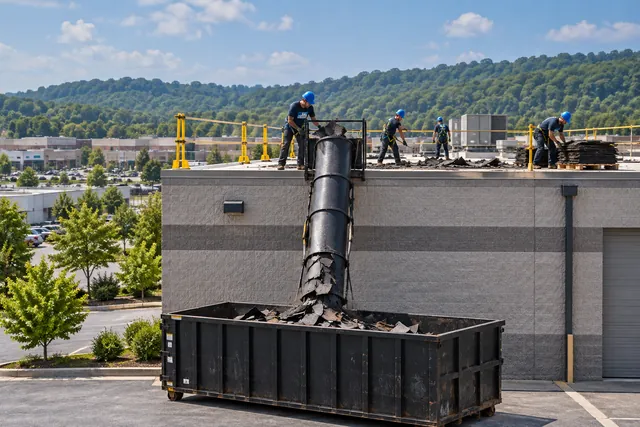
Recover or tear-off for built-up, mod bit, and single-ply roofs where repairs keep chasing the same leaks.
Flat Roofing details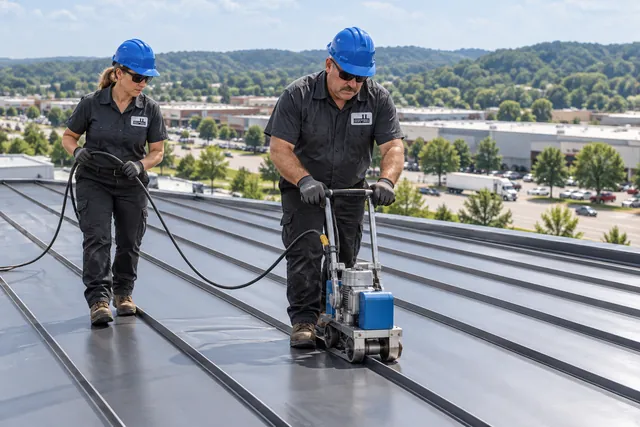
New fasteners, resealed laps, and swapped panels for steel roofs, or a new standing seam roof once rust wins.
Commercial Metal Roofing detailsPlain answers on leak repair, cost drivers, and what happens after the fix.
Wind-driven and heavy rain push water into openings that light rain never reaches, such as laps facing the weather and the tops of curbs. We check those details first, then use a moisture meter and, if needed, a controlled hose test working upslope from the stain.
Usually, with preparation. Weathered TPO needs a cleaner to strip the surface before a hot-air weld will hold. Older EPDM gets scrubbed to fresh rubber and primed before seam tape goes on. Once the sheet turns brittle or shrinks hard at the walls, patching stops being worth the cost.
Access, the roof system, and how much wet insulation sits around the leak drive it more than the patch itself. A drain repair on a one-story roof with a hatch differs a lot from flashing work up a tall parapet. The inspection measures what has to come out, so the estimate reflects your roof.
Yes. Curb flashing, counterflashing, and the cricket on the upslope side of each unit are some of the most common repair points on a commercial roof. When an HVAC contractor has to lift or move the unit, we work around their schedule and reflash the curb afterward.
That depends on the policy and on what caused the damage, and only your insurer can answer it. Storm damage such as hail bruising or wind-torn edges is treated differently from wear. Dated photos of the damage and the repair help when you file a claim.
Twice a year, in spring and fall, plus after hail or high wind. Each walk covers seams, drains and scuppers, curb flashing, and edge metal. Problems found on those walks cost less to fix than the ceiling and stock damage a missed leak causes.
Tell us where the water shows up and what kind of roof is overhead. We will trace the leak and give you a free repair estimate.