
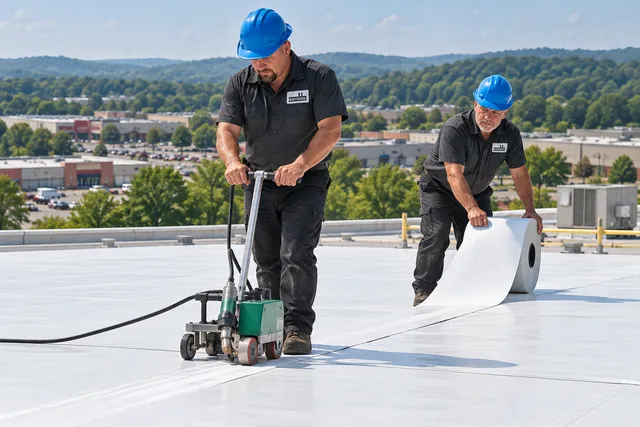
TPO Roofing
Welded white membrane for the open field away from exhaust, often over tapered insulation and cover board.
TPO Roofing details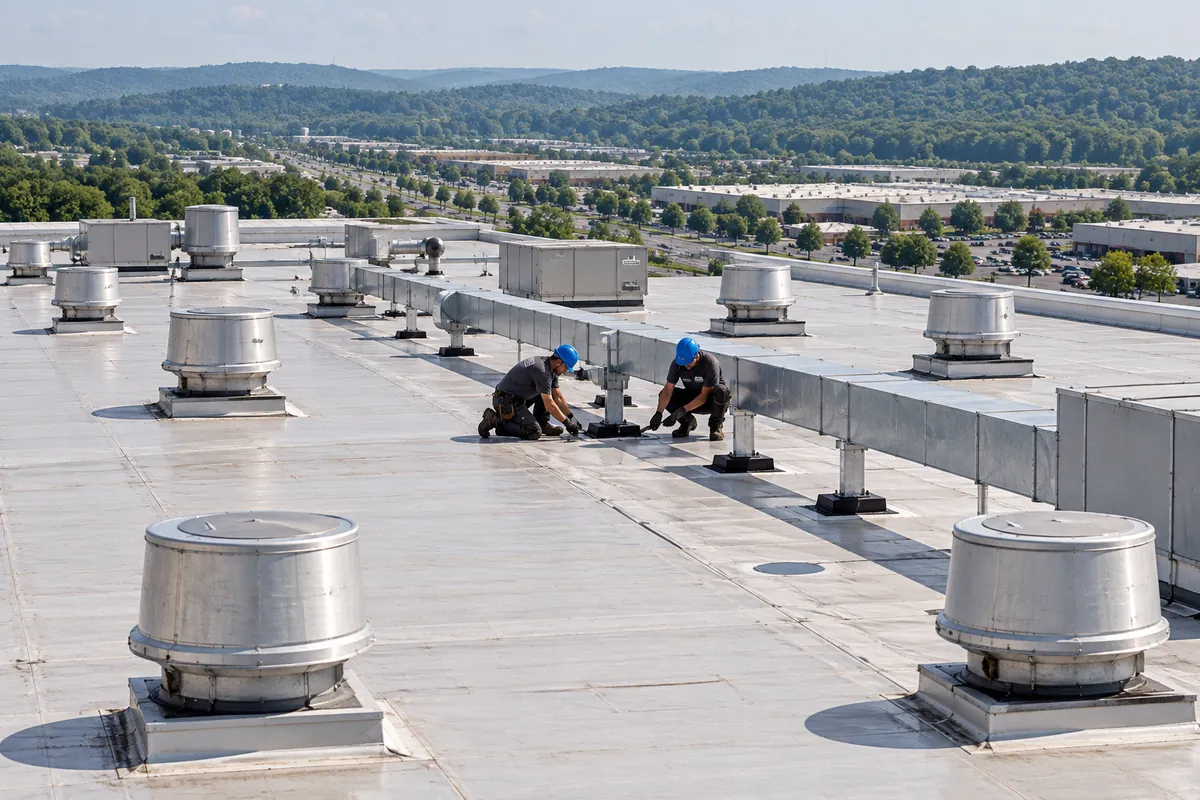
Industrial Roofing · Florence, KY
As a Florence industrial roofing contractor, we roof plants, process buildings, and distribution centers in sections while production keeps running below.
A Florence industrial roofing contractor sorts out what lands on the roof and what the deck can carry before picking a membrane. These lists show the two sides of that check.
Plant roofs wear in ways retail roofs rarely do. The chip on each shows how quickly it needs a crew.
Oils, solvents, and acid mist each attack membranes differently. Softened or swollen sheet around a discharge zone means that area needs a resistant membrane or pads.
Daily service traffic to fans, hoods, and pipe racks scuffs and punctures the membrane. High-density cover board and walkway pads take that wear.
A long building grows and shrinks with temperature. Bellows and flexible covers split with age, and water drops straight into the plant.
Water over machinery or product can stop a line. Large curbs, hoods, and pipe penetrations above process areas get checked first on every walk.
Puddles collecting around older rooftop units hint at deck deflection. That needs a structural look before more weight goes up.
New units set by crane often leave curbs half-flashed. Each swap should end with the curb welded into the membrane and a cricket upslope.
The right plant roof protects three things: the roof assembly itself, the operation inside, and the long-range maintenance budget.
Resistant sheets or protective pads around each discharge zone stop oils and chemicals from softening the roof.
Raised expansion joint curbs with flexible covers let the structure move without tearing the field membrane.
Sections sealed every evening keep water off machinery, product, and electrical gear while the roof is replaced.
Odor and fume control at RTU fresh-air intakes is planned with plant staff before adhered work starts.
Crane picks and noisy fastening are timed outside shift changes and busy shipping windows.
New curbs and rails go in during the reroof, flashed and sloped, instead of being cut into a new roof later.
Plant roofs often use more than one product. The table shows which goes where.
| Roof Area | Common Choice | Why |
|---|---|---|
| Open field away from exhaust | TPO or EPDM | Wide sheets, few seams, lower cost per square foot |
| Around grease or oil exhaust | PVC or protective pads | Better resistance to oils and grease |
| Service paths | Walkway pads over cover board | Takes boots, carts, and dropped tools |
| Expansion joints | Raised curb with flexible cover | Lets the building move without tearing |
| Exhaust stacks | Taller curbs with drainage | Keeps condensate off the flashing |
Call with the bay or column line and what sits below the water. We will start at the curbs and hoods above it.
Call UsPhased work that keeps production running, from the first survey to the last expansion joint.
The survey maps every fan, hood, pipe rack, curb, expansion joint, and drain. Cores show the insulation, and the underside of the deck is checked from inside for rust.
Plant staff help name what each exhaust carries. Manufacturer chemical resistance charts then set which membrane or pad goes in each discharge zone.
Roof areas are scheduled with plant management around hot work rules, intake fumes, crane picks outside shift changes, and debris routes clear of docks.
Crews open, insulate, and seal one section at a time. Temporary tie-ins at the end of each day join the new roof to the old at the edge of the work.
Expansion joints get raised curbs and flexible covers. Large curbs, rails, and stacks get custom flashing, with crickets on the upslope side of each unit.
Most plants mix systems. These pages cover the pieces that show up on industrial roofs.
Welded white membrane for the open field away from exhaust, often over tapered insulation and cover board.
TPO Roofing details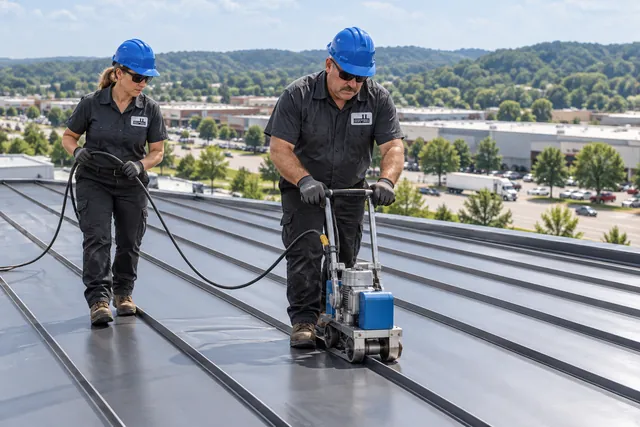
Standing seam and R-panel roofs on process bays, shops, and storage buildings around the plant.
Commercial Metal Roofing details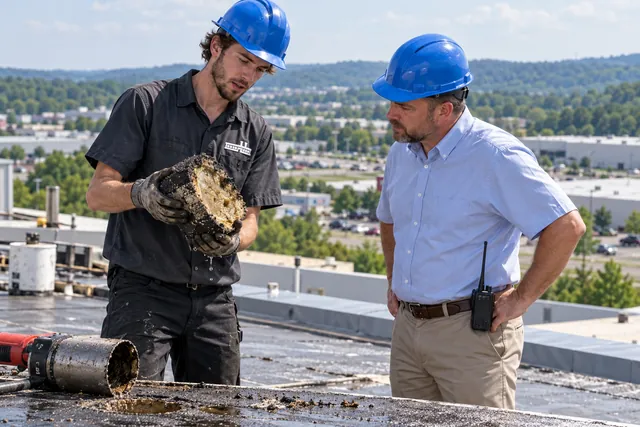
Leak tracing and flashing repairs at fans, hoods, and expansion joints between full replacements.
Commercial Roof Repair detailsThe five industrial questions from the owner file, answered for Florence plants.
Plant and distribution roofs face heat, exhaust, chemical fallout, heavy equipment, and constant service traffic. A roof over a production line carries fans, ductwork, hoods, and pipe racks that a retail roof rarely sees, so the assembly uses thicker membranes, high-density cover boards, walkway pads, resistant sheets near exhaust, and phased work around production.
The one rated for what actually lands on the roof, so the first step is identifying the exhaust. Grease, oils, solvents, and acid mist each attack sheets differently, and manufacturers publish resistance charts. Plants often run one membrane on the field and a resistant sheet or pads around each discharge, with grease boxes and taller stack curbs.
In small sections that are opened, insulated, and sealed before the crew leaves, so every night ends watertight. Planning with plant management covers hot work near flammables and dust, intake fumes, crane picks outside shift changes, and debris chutes away from docks. Temporary tie-ins seal the new roof to the old at the edge of each day.
That is a structural question for an engineer, and we flag it before new curbs or rails go in. Steel decks on bar joists have set load limits, and older plants added weight over decades. Ponding around units, sagging between joists, and deck rust seen from inside are warning signs. New equipment gets flashed curbs and crickets.
Long buildings move with temperature, and a membrane stretched across that movement tears. Raised expansion joint curbs carry flexible covers or bellows high enough to stay dry, and area dividers break big fields into sections. Drains near joints get extra attention because the joint can tilt the deck and shift where water collects.
Tell us what the plant makes, what vents onto the roof, and when bays can be worked. We will survey it and plan the phases.